What is Amazon FBA wholesale, and how does it work?
Amazon FBA wholesale is a way of selling on Amazon where you buy name-brand products in bulk from the brand or one of its authorized distributors, send them to Amazon's warehouses, and sell them on listings that already exist. Amazon stores, ships and handles returns for a fee. You keep what's left after Amazon's fees and your cost.
- The chain runs from the brand, through its distributors, to you, into Amazon's warehouses and out to the buyer. Amazon's own guide says branded products should come from the brand or its direct distributors or wholesalers.
- You find suppliers, buy, prep, label, ship to Amazon and set your price. Amazon stores the stock, ships each order, handles returns and customer service, and decides whose offer shoppers see first.
- Every sale pays Amazon's fees before you see a dollar. Your profit is what's left after those fees and your landed cost.
- You pay your supplier up front, and Amazon generally settles seller accounts every two weeks, so your cash sits in stock in between.
- Prep and labels are your job. Amazon stopped prepping and labeling units for US FBA shipments in 2026, and resellers must now put an Amazon barcode on each unit.
If you've heard people talk about "doing wholesale on Amazon" and wondered what it actually involves, this is the plain version. It covers who you buy from, how the goods get to Amazon, who does which job, and where the money goes when something sells. By the end you should be able to explain the whole model to someone else, and know whether it's worth learning more.
One thing to clear up first. People who search for "Amazon wholesale" sometimes mean buying in bulk from Amazon, or buying pallets of Amazon returns. This page is about the other direction: buying from brands and their distributors, and selling to Amazon's shoppers.
How Amazon wholesale works, from brand to buyer
Every product in a wholesale business passes through the same chain. The company names change from one category to the next, but the shape doesn't.
| Link in the chain | What it does | What it means for you |
|---|---|---|
| The brand | Makes the product, owns the trademark, and decides who it sells to. Large brands mostly sell through distributors rather than to small resellers. | A brand that won't open an account for you may still tell you which distributors carry its products. |
| Distributors and wholesalers | Buy from the brand in volume and sell by the case to retailers, Amazon sellers included. | This is where most new wholesale sellers open their first accounts. Their invoices are what Amazon asks for when a product needs approval. |
| You, the reseller | Buy by the case, prep and label the units, send them to Amazon, and set the price. | Your margin is the gap between what each unit costs you to land at Amazon and what Amazon pays you after its fees. |
| Amazon, through FBA | Receives and stores your stock, then picks, packs and ships each order and handles returns. | You pay for that service on every unit sold, and for the space your stock takes up. |
| The buyer | Finds the product on Amazon and buys from whichever offer Amazon features. | The buyer sees the brand's product page and your offer on it. They never see your supplier. |
Stef, who teaches Apex University, draws the chain in more detail in his Finding Suppliers lesson. The manufacturer sits at the top. Below it are redistributors, which buy truckloads every week and supply smaller distributors. Those distributors sell to wholesalers, and wholesalers sell to the retailers who reach the end customer. His advice is to start with wholesalers and distributors while you don't have much capital, and work up the chain toward redistributors as you grow.
In his experience, going straight to the manufacturer isn't automatically the cheapest route, because a small seller can't buy in the volumes a redistributor does. His summary of the difference in scale:
"They're supplying the United States. You are supplying the Amazon Marketplace."
That's from Stef's lesson Finding Suppliers, 3:00. The supply chain part of the lesson starts at 1:49.
Where you buy in that chain matters to Amazon too.
That's why a store's clearance shelf or a liquidation pallet isn't wholesale, even when the price looks like a wholesale price. Amazon's guide to reselling says auctions and liquidation are not valid sources of supply. Amazon wholesale suppliers covers how to find and check distributors, and a letter of authorization is how a brand puts its permission in writing.
What you do and what Amazon does
FBA stands for Fulfillment by Amazon. It's the service that makes this model workable for a small business: you send your stock to Amazon in bulk, and Amazon handles the individual orders. Here's how the work splits.
| The job | Who does it |
|---|---|
| Find suppliers and open wholesale accounts | You |
| Get approval for gated categories and brands | You apply, and Amazon decides |
| Choose products and pay the supplier | You |
| Prep each unit and put an Amazon barcode label on it | You, or a prep center you hire |
| Ship cases into Amazon's warehouses | You, through Amazon's Send to Amazon workflow |
| Store the stock, then pick, pack and ship each order | Amazon |
| Customer service and returns on those orders | Amazon |
| Set your price and keep the product in stock | You |
| Decide which offer shoppers see first | Amazon |
| Collect the buyer's payment and pay you out | Amazon |
| Keep the invoices and records for everything you sell | You |
Amazon's own FBA page describes its side the same way: it receives and stores your inventory, packs and ships orders, and handles customer service and returns on your behalf. It also says FBA products are eligible for Prime's free two-day shipping, which is a big reason wholesale sellers use it.
Stef's first lesson makes the same choice, and most of Apex University assumes FBA. He explains why in one line:
"Now, when you have Amazon do the shipping, tons of positive things come from it."
That's from Stef's lesson The Game, 6:14. The two he names are that you don't handle every order that comes into your store, and that your products become Prime eligible, which in his experience sells more than shipping orders yourself.
That alternative, shipping each order yourself, is what sellers call FBM (fulfilled by merchant). You avoid Amazon's storage charges, but every order, return and late shipment is yours to manage. Is Amazon FBA worth it compares the two for someone just starting.
Three parts of your side of the table surprise new sellers more than the rest.
You sell on a page that already exists. When the product is already in Amazon's catalog, you don't build a listing. You add your offer to the existing product page, next to every other seller of the same item, and Amazon chooses which offer goes in the box with the Add to Cart button. Amazon calls it the Featured Offer. It says featured offers are commonly priced at or below the lowest alternatives, and that an item that's out of stock can't be featured. Reselling on Amazon explains shared listings in more depth.
Labels and prep are your job now. Amazon stopped offering prep and item labeling for US FBA shipments on January 1, 2026 (Amazon's developer notice). For inventory shipped on or after March 31, 2026, resellers who aren't the brand's Brand Representative must put Amazon barcode stickers on their units, even when the product already has a manufacturer barcode (Amazon's announcement). FNSKU labels explained shows how to label, and FBA prep centers covers paying someone else to do it.
Reorders are the business. Once a product sells, the job becomes keeping it in stock. In his Restocking lesson, Stef breaks the wait for new stock into three parts: the supplier's lead time to your warehouse or prep center, the days it takes to prep and label, and the trip into Amazon until the units can be sold (Restocking, 0:31). Reorder with that whole wait in mind, or the product sells out while the next case is still on a truck. This is also the part of wholesale that builds on itself, because a supplier and a product you checked once can be bought again and again.
How money flows on one sale
A sale on Amazon isn't one payment from a buyer to you. The buyer pays Amazon. Amazon takes its fees out of that sale, holds the rest for a while, and pays you later. Your supplier was paid long before any of that happened.
Where the sale price goes
Here are the main slices of an FBA sale and who keeps each one. The amounts depend on the product, so the table says how each one is set and where the details live.
| Slice | Who keeps it | How it's set | Read more |
|---|---|---|---|
| Referral fee | Amazon | A percentage of the total sale price, or a per-item minimum, whichever is greater. The rate depends on the category. | Referral fees by category |
| FBA fulfillment fee | Amazon | Per unit sold, by the product's size tier and weight | Size tiers and fulfillment fees |
| Inbound placement fee | Amazon | Per unit on shipments into Amazon, depending on how your shipment is split | The inbound placement fee |
| Monthly storage | Amazon | By the space your units take up, for every month they sit unsold | FBA storage fees |
| Cost of goods | Your supplier | The unit price on the supplier's invoice | Analyzing a price list |
| Prep, labels and shipping to Amazon | Your prep center and the carrier | Per unit, per box or by weight | FBA prep centers |
| What's left | You | The sale price minus everything above | Profit calculator |
Placement and storage aren't taken out of the sale itself. Amazon charges them separately, but they're still part of what each unit costs you, so count them per unit when you check a product. A few other fees only apply in some cases, such as returns processing and old inventory that sits too long, and the fees guide below lists them.
The referral fee is the one every sale pays. Amazon's pricing page says that for every item sold you pay a percentage of the total price or a minimum amount, whichever is greater, and that the rate varies by category. Here's the row for one category many wholesale sellers buy in. The full table is in Amazon referral fees by category.
| Category | Referral fee | Minimum |
|---|---|---|
| Grocery and Gourmet | 8% at $15.00 or less; 15% above $15.00 | None listed |
- A product's fee category may not be the same as the category shoppers see in the Amazon store.
Source: Selling plans and pricing, Amazon
On top of the per-sale fees, Amazon charges for the selling plan itself: a monthly subscription on the Professional plan, or a fee for every item sold on the Individual plan. The Amazon FBA fees guide covers both plans and every fee in the table.
Your cost of goods plus everything it takes to get a unit into Amazon's warehouses (prep, labels, inbound shipping and the placement fee) is your landed cost. In the Purchasing lesson, Stef builds the landed cost of one two-pack listing line by line: the supplier's unit cost, a prep charge, inbound shipping estimated by weight, and Amazon's placement fee. His definition is the one to keep:
"So when you read landed cost, this is the true dollar amount that it will cost you to bring this inventory inside Amazon Fulfillment Centers."
That's from Stef's lesson Purchasing, 4:51. The example starts at 4:15, and it was filmed on an older version of Apex.
One real listing, worked through
Here's the arithmetic on a real product page, with the Apex for Amazon Sellers panel open beside it.
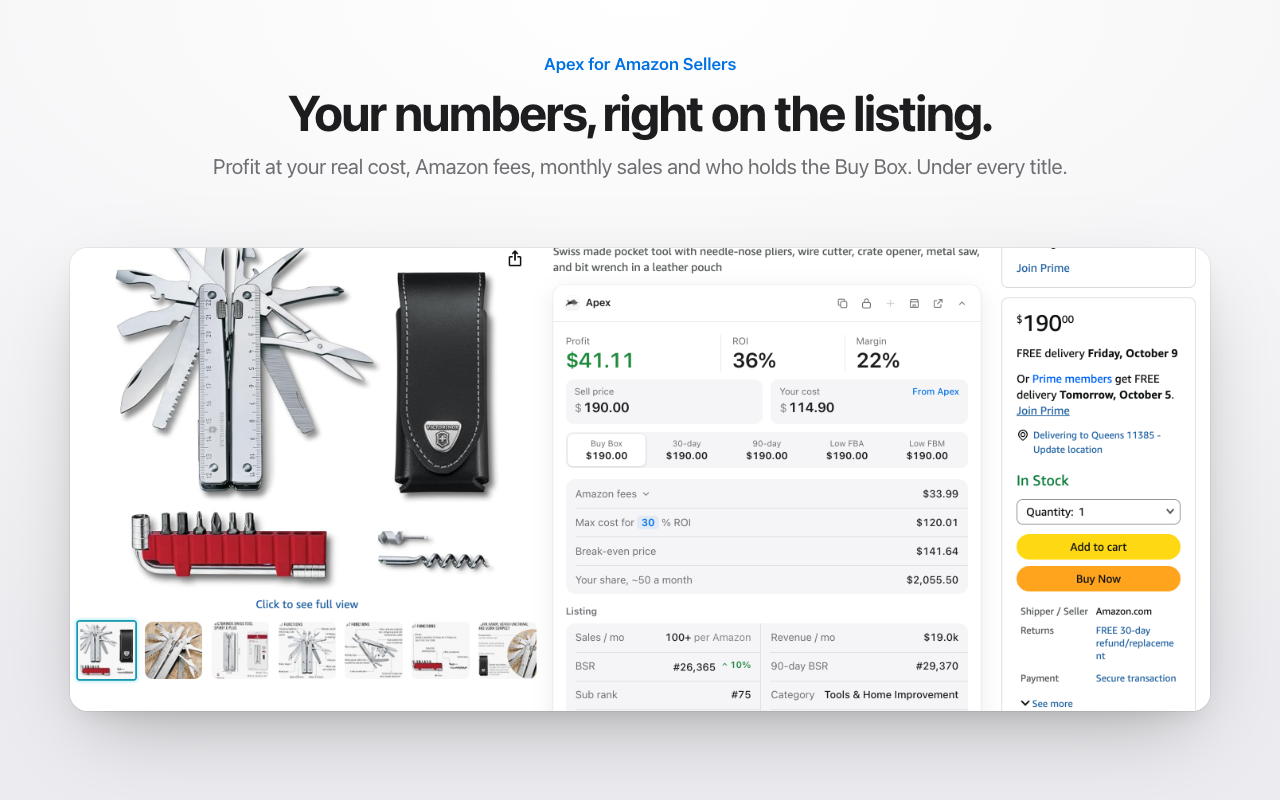
Read the panel from the top. On the day of the capture, the listing sold for $190. Take away Amazon's fees on that sale, shown as one line, and the $114.90 unit cost the panel pulled from Apex, and $41.11 is left. That's a 22% margin on the sale price and a 36% return on the cost.
Treat it as one illustration of the arithmetic, not a typical result. The cost line is whatever cost was saved in Apex for that product, standing in for your own supplier's price, and prices and fees move. Notice, too, who holds the Featured Offer box on the right: Amazon itself. Our rule of thumb, and it's ours rather than Amazon's, is that a listing Amazon sells itself is a hard one for a reseller to win sales on. Reselling on Amazon explains why it's one of the first things to check.
Two more lines in the panel answer the questions a wholesale buyer asks before ordering: the most you can pay per unit and still make a 30% return, and the break-even price, the lowest sale price before a sale starts losing money.
You can run the same arithmetic on any product. The profit calculator is free: unlimited, no sign-in. The FBA calculator looks up Amazon's price and fees from an ASIN: 3 free lookups, then sign in with a plan.
When the money moves
The split above is only half of it. The order the money moves in matters just as much.
- You pay the supplier first. A new account usually pays before the order ships. Payment terms tend to come later, once you have a history with the supplier, as opening a wholesale account explains.
- Your cash sits in stock. It's in transit, at the prep center, then on Amazon's shelves, until each unit sells.
- Amazon holds each sale for a while. Its page on how seller payments work says that with deliveries, Amazon typically reserves funds for seven days.
- Amazon pays out on a cycle. The same page says that in general, Amazon settles seller accounts every two weeks, and a transfer can take up to five business days to reach your bank.
So a first order comes back in pieces, one unit at a time, and a product that sells well asks you to reorder before the first order has fully paid you back. That's why the cash you keep in reserve matters as much as the cash you spend. Is Amazon FBA worth it walks through one full cycle.
Wholesale next to the other models
Wholesale is one of several ways to resell on Amazon: arbitrage buys discounted stock from other retailers one deal at a time, and private label builds a brand of its own instead. Reselling on Amazon puts every model side by side with the rule Amazon applies to each, and wholesale vs private label and online arbitrage vs retail arbitrage go deeper on each pair.
What it takes to start
Before a first order, wholesale needs a business that distributors will sell to (many ask for a resale certificate), an Amazon selling account, approval for any gated categories or brands you want to sell, at least one supplier account, and money for a first order plus a cushion to reorder. How to start Amazon wholesale puts those in order, how much it costs to start works through budgets, and the Amazon wholesale roadmap lays out every stage after this one, each with a step that costs nothing.
Where Apex fits
You don't need software to understand any of this, and you don't need it for a first order. Apex is the software we build for sellers who run this model once there are more suppliers, price lists and purchase orders than a spreadsheet handles well. Each part of it maps to a link in the chain above.
- Supplier price lists. Apex Green matches a distributor's price list to Amazon by UPC, then filters the matches by profit, ROI, sales rank and competition.
- Suppliers, purchase orders and profit. Apex Blue keeps your suppliers, purchase orders, landed cost, profit and loss, and restock planning in one place.
- Pricing. Apex Repricer, the repricer, works out a floor for each listing from your own cost and Amazon's fees. It's in beta. The repricer is part of the Pro plan. Turn on autopilot and Apex runs your strategies every 5, 15, 30 or 60 minutes, or press Reprice now. Repricing the instant a competitor changes price is built but not switched on yet.
- Prep and shipments. Apex Red handles shipments and prep center work. It's in beta and opened by invitation.
- Learning the model. Apex University is the course this page quotes. It comes with a free Apex account: nine lessons, no card.
Here's what the first of those looks like: a supplier's price list matched to Amazon, line by line.
There's nothing to buy at this stage. Learn the model, set up the business, and come back to software when your first supplier sends a price list. The browser extension in the screenshot above comes after the course. It's free to install, and its numbers open when you finish Apex University.
Questions about how Amazon wholesale works
Is Amazon wholesale the same as buying wholesale from Amazon?
No. Among resellers, Amazon wholesale means buying from brands and their distributors and selling to Amazon's shoppers. Amazon's own seller blog uses the word the other way round: its guide to selling wholesale on Amazon is about selling in bulk to business buyers through Amazon Business. Pallets of Amazon customer returns are a third thing again, and Amazon's guide to reselling says liquidation is not a valid source of supply for products you resell.
Is Amazon FBA wholesale different from Amazon FBA?
They describe two different things. FBA is the fulfillment service: Amazon stores your stock and ships your orders. Wholesale is where your stock comes from: brands and their distributors. Most wholesale sellers use FBA, but you can sell wholesale stock and ship the orders yourself, and private label sellers use FBA too. "Amazon FBA wholesale" just means the two together.
What is the difference between a distributor and a wholesaler?
The words overlap, and suppliers use them loosely. Roughly, a distributor buys from the brand in large volumes and supplies other businesses, and a wholesaler often buys from distributors and sells smaller quantities to retailers. Amazon's guide to finding wholesalers calls a wholesaler a middleman between manufacturers and sellers. For an Amazon seller the label matters less than two questions: is this supplier the brand, or authorized by it, and will its invoice show what Amazon asks for when a product needs approval? Amazon ungating invoice requirements covers what Amazon looks for on that invoice.
Do I create my own product listing when I sell wholesale?
Usually not. If the product is already in Amazon's catalog, you add your offer to the existing product page, and Amazon's ASIN creation policy asks sellers not to create a second page for an item that already has one. That policy lives on a Seller Central help page that needs a sign-in, so we couldn't check its current wording, and it's listed in the sources below. On a shared page you compete with the other sellers on price, stock and service, not on the listing itself.
Apex University comes with a free Apex account: nine lessons, no card.
Start Apex UniversityYou don't need to pay for anything at this stage.
Sources
- How to find wholesalers, Amazon
- Fulfillment by Amazon, Amazon
- Selling plans and pricing, Amazon
- How Amazon seller payments work, Amazon
- Maximize your sales potential with the Featured Offer, Amazon
- Guide to reselling in Amazon stores, Amazon
- ASIN creation policy, Amazon Seller Central
- Commingling practices will end effective March 31, 2026 (US notice), Amazon Seller Forums (News_Amazon)
- SP-API changelog: US FBA prep and labeling services end, Amazon Selling Partner API
- How to sell wholesale on Amazon, Amazon
Some of Amazon's pages need a Seller Central sign-in to read, and we have not yet checked their current wording for this version of the page. If Amazon's page and this guide disagree, Amazon's page is the one that counts.
How do I start? Do I need an LLC, an EIN and a resale certificate? How much money?